
Blog
View all

And the Winners Are: Recapping the CockroachDB × AWS Hackathon - Build with Agentic Memory

Rob Reid
October 2, 2026
9 Reasons to Choose Cockroach Continuum for Agentic Database Growth
Agent-driven development turns database growth into an estate-management problem. Cockroach Continuum helps teams create, manage, and consolidate workloads as one system, without a proportional increase in operational work or cost.

Tara Jana
September 30, 2026

CockroachDB BYOC Is Now Generally Available
Run CockroachDB in your cloud account while Cockroach Labs manages operations, security, backups, and uptime. Available on AWS, Azure, and GCP.

Ethan Shmargad
September 24, 2026

Scale the Database Estate, Not the Team
Platform teams can scale a database estate without scaling cluster-by-cluster operations by separating workload isolation from dedicated infrastructure. Cockroach Continuum Virtual Clusters provide isolated environments on a shared Dedicated Host Cluster, enabling centralized operations and estate-level capacity planning.

Ankit Pranav
September 22, 2026
Cloud
Scale & Resilience
Cockroach Continuum: the Agentic Database Cloud
Utility-grade databases operated without seams from 1/1000th of a core to ten thousand.

Spencer Kimball
September 15, 2026
ai
Cloud
Distributed SQL
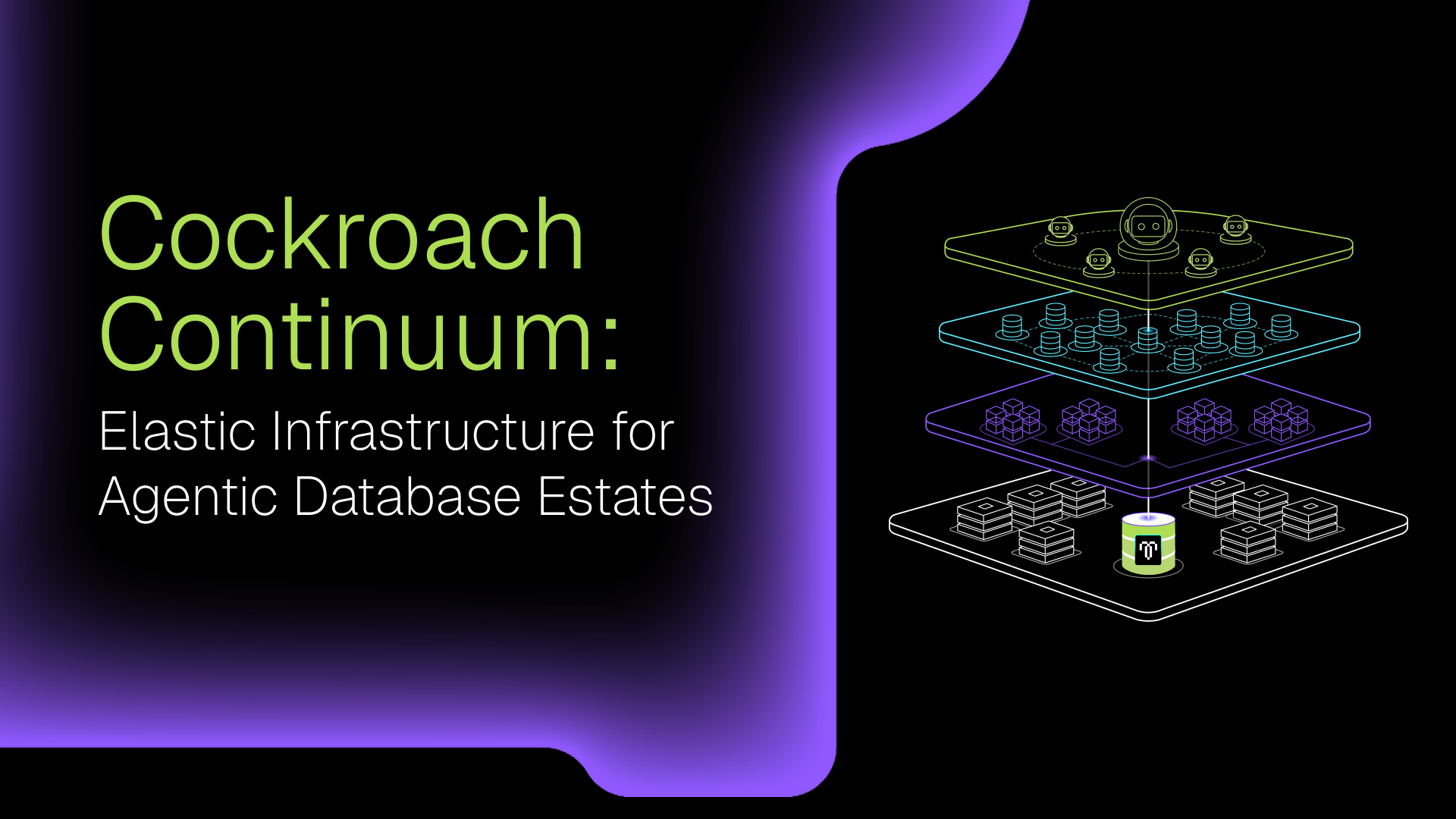
Cockroach Continuum: Elastic Infrastructure for Agentic Database Estates
Cockroach Continuum uses elasticity in the storage, KV, and SQL layers to make database estate consolidation practical while preserving CockroachDB’s reliability, scale, locality, and correctness.

Isaac Wong
September 15, 2026

ai
Protecting Cockroach Labs' Source Code in the Age of AI
Our customers rely on us to deliver a database that survives outages, scales globally, and evolves fast enough to meet requirements that change in unpredictable ways. That mission drives every decision we make, including how we manage and distribute our source code.

Peter Mattis
September 15, 2026

ai
Identity Access Management (IAM)
How Does CockroachDB Automate SQL User Lifecycle Management?
Fortune 1000 enterprises widely rely on major Identity Provider (IdP) and Identity and Access Management (IAM) platforms like Okta, Microsoft Entra ID, Microsoft Active Directory, and Ory.

Pritesh Lahoti
August 28, 2026

Core Banking Modernization with Temenos Core and CockroachDB
Banking has become an always-on business. Customers expect instant payments, accurate balances, and continuous access to financial services...

Nanda Badrappan
August 24, 2026

ai
A2A Is Now an Open Standard. The Data Layer Underneath It Isn't.
In April 2025, Google released a protocol for agent-to-agent communication. Within three months, Google had donated it to the Linux Foundation...

Quentin Packard
August 19, 2026
Get started for free