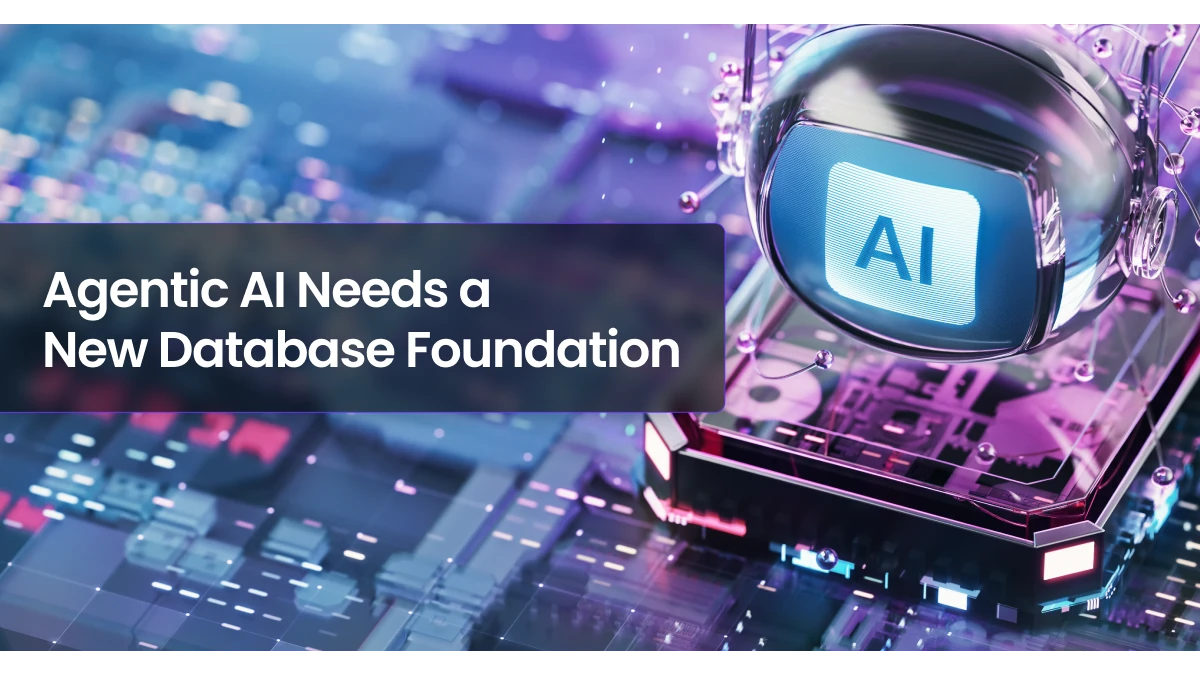
Agentic AI systems represent a big shift for artificial intelligence: from stateless inference to autonomous, long-running software agents that plan, reason, act, observe outcomes, and adapt over time. These agents operate continuously, coordinate with other agents and tools, and maintain evolving state across complex workflows.
This shift introduces a fundamentally new set of requirements at the database layer – requirements that many existing data architectures were never designed to meet.
What is the database challenge behind agentic AI?
Traditional applications interact with databases through transactions that are short-lived and predictable. Agentic AI breaks this model: Agents are stateful and highly concurrent, continuously reading and writing shared state such as goals, plans, memories, intermediate results, and task queues.
From a database perspective, several new challenges emerge with agentic AI:
Write-heavy concurrency: Thousands of agents may update shared data simultaneously, stressing locking, isolation, and throughput.
Multi-step workflows: Agent actions often require a sequence of dependent reads and writes, where partial failure can lead to duplicated work or inconsistent outcomes.
Correctness under failure: Infrastructure failures, retries, or network partitions cannot be allowed to corrupt long-running agent state.
Global execution: Agents increasingly operate across regions, requiring low-latency access and consistent state worldwide.
When databases rely on eventual consistency, external coordination systems, or application-level compensation logic, correctness becomes fragile. This forces teams to re-implement guarantees that should exist in the data layer, which slows development and increases operational risk.
What does agentic AI require from the database?
Agentic AI examples include autonomous customer support agents, self-healing infrastructure, real-time fraud detection, and AI-driven software development tools. These are powerful capabilities, but they come at a cost, as agentic workloads place unusually high demands on the database, such as:
Strong consistency so agents always reason over correct, current state
Serializable transactions to safely execute multi-step agent actions
High write concurrency without sacrificing correctness
Built-in resilience to survive node, zone, or regional failures
Horizontal scalability both -up and -down, as traffic fluctuates and the number of agents grows
Data locality to keep data near the agents and the customers they’re supporting
Postgres-compability so that familiar tools and procedures can be reused in an AI environment
These properties are not optional. Without them, autonomous systems become difficult to reason about, debug, and trust – slowing adoption, increasing operational risk, and limiting their business value.
Why is distributed SQL optimal for agentic AI?
Data architects face a familiar but high-stakes decision when planning for agentic AI: Extend existing relational databases, adopt NoSQL or event-driven architectures, or introduce specialized systems to handle scale and concurrency? Each option addresses part of the problem, but often at the cost of consistency, operational simplicity, or correctness.
The solution is distributed SQL databases, which are uniquely well-suited for agentic workloads. Distributed SQL is best for agentic AI because it combines the correctness guarantees of relational databases with the scale and resilience of distributed systems.
RELATED
Why Agentic Applications Need Deterministic Foundations
Why choose CockroachDB for agentic AI?
CockroachDB is a distributed SQL database that’s designed to be the system of coordination for distributed, autonomous applications. This makes it a natural fit for the unique challenges and extreme requirements of agentic AI.
Strong consistency and serializable transactions CockroachDB provides strict serializable isolation by default. For agentic systems, this ensures agents never act on stale or partially updated state. Complex agent workflows such as task claiming, planning updates, or tool invocation can be executed atomically, even under extreme concurrency.
Horizontal scalability for agent concurrency As agent counts increase, write throughput must scale alongside them. CockroachDB scales horizontally, allowing teams to add or remove capacity without redesigning schemas or sharding logic. Thousands or millions of agents can safely operate in parallel against the same logical database.
Resilience without application-level complexity Agentic systems are long-running by nature, persisting state and acting continuously rather than executing single, isolated tasks. CockroachDB’s active-active architecture ensures that the agent state survives infrastructure failures without manual recovery or custom retry orchestration in the application layer.
Global distribution for agent execution Agents often run close to users, tools, or data sources across regions. CockroachDB’s geo-distribution capabilities allow teams to place data close to where agents operate, while maintaining a single, consistent view of the system.
Postgres-compatible relational modeling for agent state Despite their autonomy, agents still rely on structured data: tasks, dependencies, permissions, audit logs, and outcomes. CockroachDB allows teams to model agent behavior using familiar Postgres-compatible relational constructs – tables, indexes, constraints – without sacrificing scale or correctness. At the same time, CockroachDB supports vector data representation to simplify the integration of vectors with transactional data. CockroachDB has also introduced C-SPANN, a vector indexing algorithm that’s designed and optimized for distributed vector indexing.
Distributed SQL: Reliable autonomy at scale
With CockroachDB, teams can treat the database as a foundational layer for agentic AI, not just a system of record. Agents coordinate through transactions, recover automatically from failures, and scale horizontally as demand grows, all without embedding complex distributed systems logic into the agent framework itself.
Agentic AI introduces autonomy and unpredictability at the application layer. CockroachDB provides the consistency, scalability (up or down), and resilience required to make that autonomy reliable in production. The result is faster deployment of agentic AI tools, with lower risk and measurable business impact.
Try CockroachDB Today
Spin up your first CockroachDB Cloud cluster in minutes. Start with $400 in free credits. Or get a free 30-day trial of CockroachDB Enterprise on self-hosted environments.
David Bressler is Staff Product Marketer for Cockroach Labs. He has worked in 26 countries, is an accomplished public speaker, and graduated with distinction with an MBA from NYU.